The RACER Mailbag, April 15
Welcome to the RACER Mailbag. Questions for any of RACER’s writers can be sent to mailbag@racer.com. We love hearing your comments and opinions, but letters that include a question are more likely to be published. Questions received after 3pm ET each Monday will be saved for the following week.
Q: Where does the purse money come from in all the different series that pay out?
Shawn, MD
MARSHALL PRUETT: To quote Charles Barkley, “C’mon, man.”
There are hundreds of series that pay out prize money, and all of those answers are not getting covered in a breezy weekly mailbag penned by a self-avowed idiot. The basic answer is: From income generated by each series. It could be from ticket sales and concession sales. Could be from sponsorships. Could be from TV revenue. Could be from personal wealth or a national sporting fund. Could be a mix of these.
Q: Can you help me understand the idea of a sale of PREMA? I get the basic logic – sell the team to someone who wants to operate it and fund it, then rejoin the series with drivers TBD. At the most basic level, it makes sense. However, zoom out a bit and I cannot see any reason someone would purchase PREMA.
IndyCar limits itself to 27 entries at everything but Indy. There are currently 25 full-time cars with 25 charters. There's room for the two PREMA cars to exist. However, both Honda and Chevy have been granted a charter as part of the new engine supplier agreements. Those charters are cars No. 26 and No. 27, which guarantee a full field and anyone else being shut out. Therefore, in 2028, PREMA or anyone else would be shut out of IndyCar except for the 500. It makes zero logical sense to buy PREMA only to run part of 2026 and 2027, and then be shut out in 2028. Maybe I'm missing something, so I'm writing in hoping you can help out.
John Balestrieri, Waukesha, WI
MP: Great questions again, John. In reverse order, yes, by 2028 with the pair of manufacturer charters, the 27-car cap would be reached. This is also in conflict to messaging we’ve heard in the background from the series about wanting to downsize the grid in order to create more demand and value for those charters.
So, rather than seeing a cut to the cap and bringing the number down to 24 cars, or something in that range for 2028, it’s actually expanding. Unrelated to PREMA, it represents a change of direction. The current rules don’t prohibit more than 27 entries, so a team could show up, provided IndyCar accepts their entries, which isn’t an automatic thing, and try to bump their way into the field at St. Pete or wherever else outside of the Indy 500.
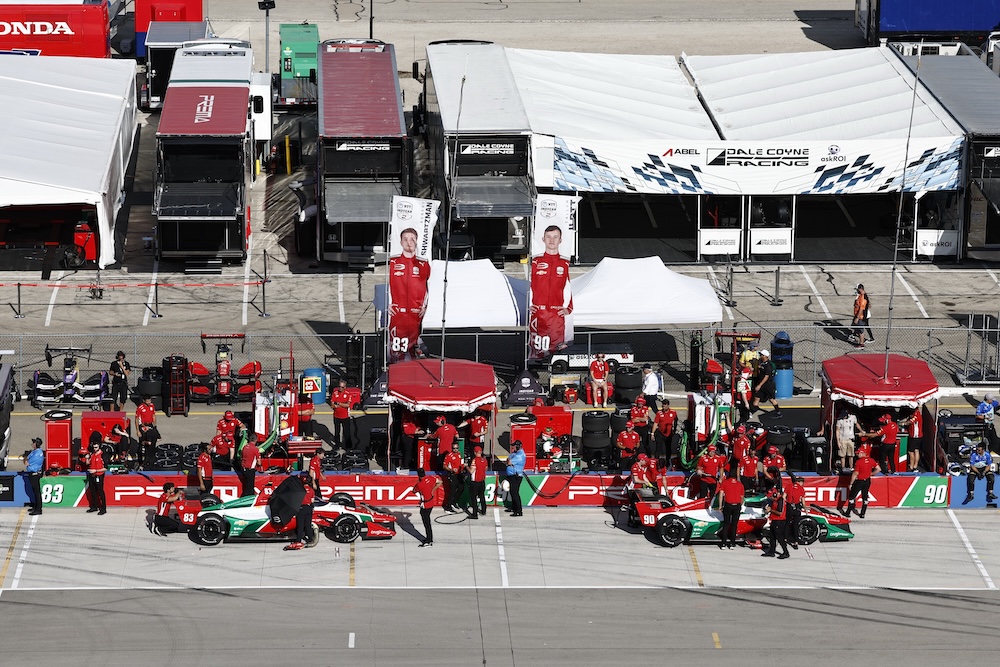
All this could be yours. (Except the people). Chris Jones/Penske Entertainment
On PREMA, this is a case of its IndyCar CEO Piers Phillips trying to save the thing he created by finding a new investor/owner to take the team from PREMA. It was Phillips’ passion project from the outset, which was met with great interest by PREMA’s wealthy owners and financially backed by those owners, Deborah Mayer and Claudio Schiavoni, the D and the C in PREMA’s parent company, DC Racing Solutions.
The start-up and launching operating budget is rumored to be as high as $50 million, which says a lot about the size and quality of the effort PREMA assembled for its first season of IndyCar racing. Said another way, this wasn’t a low-buck start-up that was done on a discount and faded back into obscurity; real money was spent on building out a big shop, buying five-plus new Dallara DW12s, new transporters, and new everything that was presented at the highest level. That’s something the builder of a top-notch program would want to protect and keep alive, which answers the primary question here.
I’m told its new potential investors have been actively pursuing charters, just as PREMA did without success while assembling itself to debut in 2025.
The main question to ask today is what a buyer would actually be buying. There’s a turnkey team, with lots of DW12s and everything required to go racing. A sizable part of the inventory and value associated with the team involves those cars and all of the spare parts, but the DW12s have about 18 months of life left before they’re replaced with the new IR28s.
So for a new investor/owner, there’s the potential of a big asking price – said to be in the $25-$30 million range by DC Racing Solutions – that includes a stockpile of cars and spares that recently cost approximately $10 million and are 18 months away from being all but worthless and needing to be replaced by five or more new IR28s and all of those new spares.
The timing of all this is terrible, and from everything I continue to hear behind the scenes, the DC folks aren’t overly motivated to sell, which is probably a dumb and obvious thing to say since we’re now into the eighth month since the 2025 season ended and no transaction has taken place. Due to the timing with new cars on the way, it makes no sense for an investor to start from scratch, buy a fleet of new DW12s, and effectively recreate PREMA with all-new money at the midpoint of 2026.
With the upcoming car changeover in mind, buying the assets of a moribund team is the only sensible move, and even then, it comes with another big round of expenditures on the horizon and no guarantees of being in the field without charters.
This is PREMA’s IndyCar CEO trying to preserve what he created. If it’s unsuccessful, I wouldn’t be surprised to see him try and start something new in IMSA, or similar, with those investors.
Presented by:


Marshall Pruett
The 2026 season marks Marshall Pruett's 40th year working in the sport. In his role today for RACER, Pruett covers open-wheel and sports car racing as a writer, reporter, photographer, and filmmaker. In his previous career, he served as a mechanic, engineer, and team manager in a variety of series, including IndyCar, IMSA, and World Challenge.
Read Marshall Pruett's articles
Latest News

Comments
Comments are disabled until you accept Social Networking Cookies. Update cookie preferences
If the dialog doesn't appear, ad-blockers are often the cause; try disabling yours or see our Social Features Support.